Chapter 1 established the philosophical stakes of social research: the difficulties created by the empiricist tradition, the ontological responses it provoked, and the confusions that arise when quantification is conflated with objectivity and when methods are treated as adequate independently of the objects they investigate. The present chapter addresses the conceptual architecture required to move beyond the problem.
Three sets of conceptual distinctions structure the argument. The first concerns the relationship between ontology, epistemology, methodology, and methods, and why it is helpful, if not necessary, to give priority to ontological questions as prerequisites for coherent methodological questions. The second concerns causality: the range of positions available in the philosophical literature and the specific demands that open social systems place on any adequate account of causal explanation. The third aspect concerns emergence and the three broad approaches to it that have shaped how social science accounts for collective properties and their causal powers. Together these three sets of distinctions constitute the conceptual foundation for the four social ontological debates in Part II.
2.1 Ontology, Epistemology, Methodology, and Methods: Critical Realist Definitions[^1]
2.1.1 The Problem of Conflation and the Case for Ontological Priority
The debate between the quantitative and qualitative methods, and the fact that it is a symptomatic treatment of a deeper, ontological issue, is not an accident. It reflects a deeper tendency in social research to collapse the transitive with the intransitive, as mentioned in 1.3. It is this transcendental argument, moving from the undeniable features of scientific practice to the conditions that makes it possible, that Bhaskar’s critical realism places at its foundation (Bhaskar, 1975). These two dimensions are irreducible to one another. Scientific progress consists precisely in developing transitive knowledge that adequately captures the intransitive dimension, even though this remains fallible and subject to revision (Bhaskar, 1975, 1979).
It is worth noting that the intransitive dimension is not a starting point that researchers occupy before theorising. It is an anchor: the standard against which the adequacy of transitive knowledge is measured (as far as possible), and the condition of possibility for theoretical revision, rational comparison of competing accounts, and the explanation of why some interventions work while others fail. This distinction between the intransitive and transitive dimensions is what makes ontological priority both possible and necessary: because reality exists independently of our knowledge of it, ontological commitments about what that reality contains must come before, and constrain, the epistemological, meta-theoretical, theoretical, methodological, and methods choices through which we attempt to know it. How these dimensions relate to one another, and why getting their relationships right matters for social research, is the subject of the sections that follow.
2.1.2 From the Intransitive Dimension to the Architecture of Social Research
Now, the intransitive/transitive distinction has established that reality exists independently of our knowledge of it, and that our knowledge is always a historically situated and fallible attempt to approximate that reality. But this immediately raises a further question: what kinds of things does the intransitive dimension contain, at least in the social domain? Not all of reality is relevant to social research in the same way. The social world has a specific character, populated by specific kinds of entities with specific kinds of properties and causal powers - but what are they really?
Identifying what those entities are, how they exist, and how they relate to one another is the central task of social ontology. Ontology is the study of what exists (in general, not just with regard to the social world), how different aspects of reality are constituted, and what properties and causal powers they possess. It is important to distinguish ontology as a philosophical discipline from being itself: ontology does not refer to mind-independent reality as such but to our systematic theorisation of what that reality looks like in its most fundamental form, thus social ontology is itself a transitive endeavour, even though it aims to specify the intransitive. Hence, when researchers grapple with ontological questions in the social domain, they are asking: what kinds of entities exist in social reality? Do individual persons, social structures, cultural meanings, and institutional arrangements all exist independently and with their own causal powers, or can some be reduced to others? How do different aspects of social reality relate to and act upon one another? These are not questions about how we know social reality but about what it is, and the answers researchers give to them, whether explicitly or implicitly, shape everything that follows (Bhaskar, 1975, 1979).
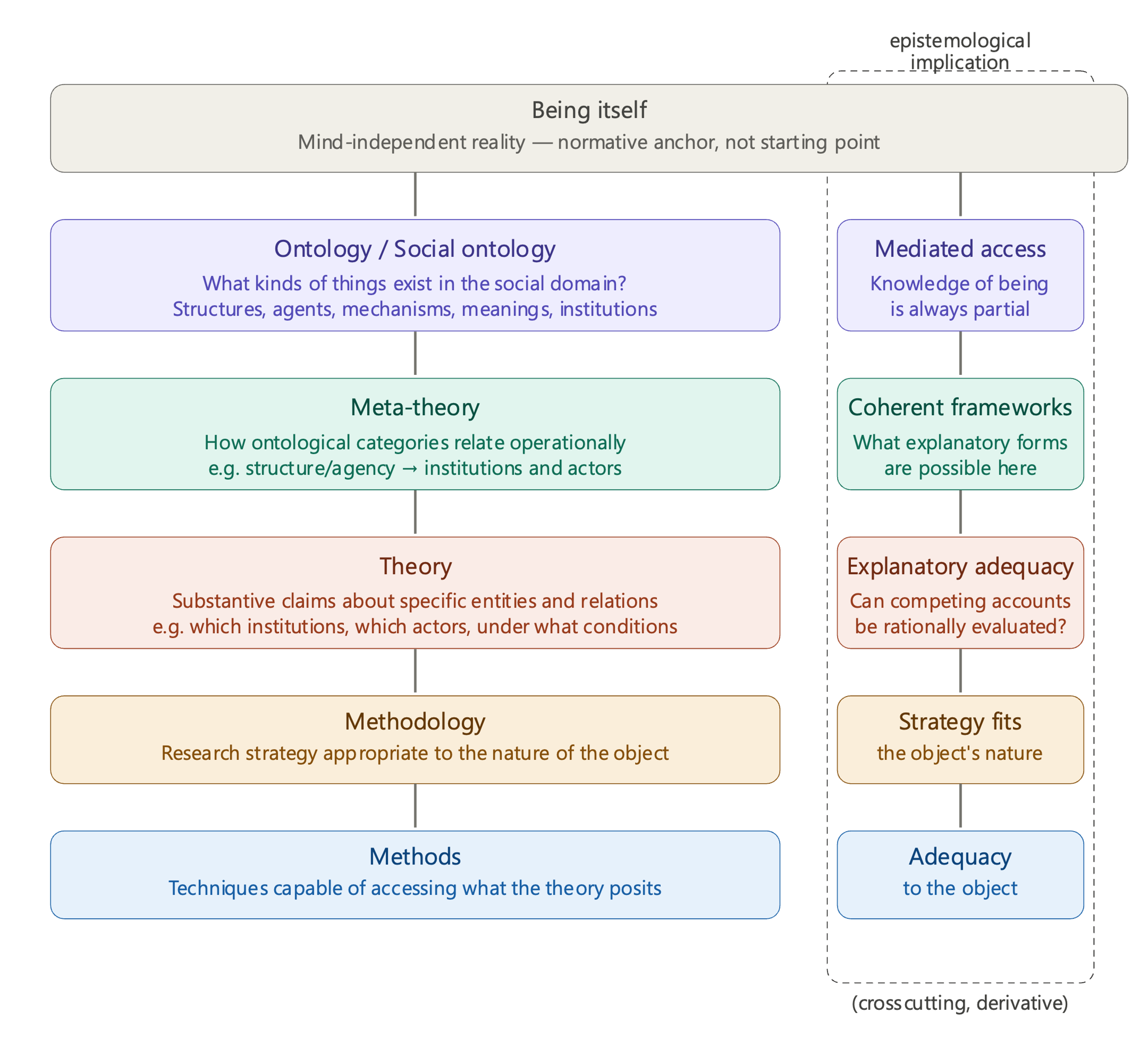
To make clear how methods, theory and ontology relate to each other, let us descend from the abstract highs of ontology and introduce the levels in between as we approach the most practical level of method. As the next lower step in terms of abstractness, we consider meta-theory, which takes the categories established at the ontological level and specifies how they relate operationally, determining the form that explanation must take without yet making any substantive claims about specific entities or mechanisms in any particular context. If for example, social ontology establishes that structure and agency are both real and irreducible, meta-theory translates this into a formal explanatory requirement: explanations must specify the terms of how institutional arrangements condition the action of actors, and how their action in turn reproduces or transforms those arrangements. Meta-theory specifies the causal logic connecting the ontological categories, the analytical units through which their interaction can be investigated, and the relational form that an adequate explanation must take. It is the intermediate level that makes the move from ontological commitment to substantive theoretical claim coherent rather than arbitrary, and it is what prevents theoretical frameworks from being constructed in ways that are inconsistent with the ontological commitments researchers claim to hold (Archer, 1995; Danermark et al., 2002).
The next level is more familiar: theory makes substantive claims about specific entities, relations, and mechanisms within the domain identified by social ontology and within the formal constraints established by meta-theory. Theoretical questions ask which institutions, which actors, under what conditions, and through what mechanisms particular social outcomes are generated. Theory is evaluated against the ontological referent that the intransitive dimension provides: competing theoretical accounts are not simply different perspectives but different attempts to capture what is actually operative in the intransitive dimension, and they can therefore be assessed in terms of their explanatory power, their coherence with evidence, and their capacity to account for why interventions based on them succeed or fail (Bhaskar, 1979; Sayer, 2000). It is at this point that the distinction between meta-theory and theory becomes fully visible. Meta-theory specifies the form of explanation: for example, that explanations must account for how structural conditions and agentive action interact across time. Theory fills that form with content: which specific institutional arrangements, operating through which specific mechanisms, conditioned the actions of which specific groups under which specific historical conditions?
Contrasting meta-theory and theory, two researchers who share the same ontological commitments may nonetheless develop different meta-theoretical frameworks, not because they are studying different phenomena, which would be a theoretical rather than a meta-theoretical consideration, but because they hold different views about the causal logic or interactions that connect the categories they both accept.
For example, one researcher could emphasise the temporal sequencing of structure and agency as analytically separable moments; another might focus on their constantly recurring mutual constitution. These are genuinely different meta-theoretical positions that carry different implications for the kinds of theoretical claims that are coherent within them (Archer, 1995). But having an adequate theoretical account of what mechanisms exist and how they operate does not yet tell us how to investigate them. After all, mechanisms are typically not directly observable; they operate at a level of depth that makes them inaccessible to straightforward empirical inspection. How, then, do we design research that can reach them?
This is what we explore in the next level, slowly becoming more concrete. Methodology addresses which research strategy is appropriate to the nature of the object being investigated. The appropriate strategy is not determined by what is most efficient, most consistent with disciplinary convention, or most likely to produce publishable results, but by what the object requires. A mechanism that operates through the interpretive frameworks of agents requires a different investigative strategy than one that operates through material resource distribution, not because one strategy is more rigorous than the other, but because the nature of the object constrains what kind of access is possible, or what the (indirectly) observable properties are that could be collected as data. Methodological choices must therefore flow from ontological and meta-theoretical commitments rather than from the availability of data or the expectations of disciplinary audiences (Sayer, 2000; Danermark et al., 2002). Knowing what strategy is appropriate, however, still leaves open the question of which specific techniques are capable of executing that strategy and generating empirical material that bears on the theoretical claims that are being evaluated.
Finally, the most graspable and highly sought after: the methods. These are the specific techniques through which empirical material is generated and then analysed. The critical question at the methods level is whether a given technique is adequate to the object: whether it can reach the kind of entity, mechanism, or relation the theoretical account identifies as causally relevant. This is what makes the quantitative/qualitative distinction a derivative rather than a foundational one. The question is never simply whether to count or to interpret, but whether the technique chosen is capable of accessing what the theory posits as existing in the intransitive dimension. A technique that can only document regularities at the surface of social life is inadequate if the theoretical account identifies depth mechanisms as causally primary; a technique designed to access subjective meaning is inadequate if the object is a structural mechanism that operates independently of whether agents are aware of it (Sayer, 2000).
Running through all of these dimensions, but irreducible to any one of them, is epistemology. Epistemology addresses how we can gain knowledge about what exists and what constitutes adequate justification for knowledge claims. It is important to note that we should be aware that epistemology as a philosophical discipline is distinct from knowledge itself, which can be understood as the actually existing body of theories, concepts, and explanatory frameworks that scientific communities produce at any given historical moment. Knowledge itself belongs to the transitive dimension; epistemology is the reflexive account of how that knowledge is produced, evaluated, and revised. Epistemology does not occupy a single position in the architecture described here. Rather, its implications are felt at every level, taking a different form as we move from ontology toward methods. At the ontological level, the epistemological implication is that our access to being itself is always mediated and partial: social ontological commitments are not direct readings of reality but theoretically informed and historically situated accounts, which means they must be held critically and remain open to revision. At the meta-theoretical level, epistemology constrains which explanatory frameworks are coherent: not all ways of relating ontological categories are equally justified, and the epistemological question is whether a given meta-theoretical framework can produce knowledge adequate to the entities it purports to explain. At the theoretical level, epistemology shapes what counts as evidence and what inference patterns are legitimate given the ontological and meta-theoretical commitments in play: different theoretical frameworks do not simply collect different kinds of data, they operate with different standards of what evidence is and what it can show. At the methodological level, epistemology specifies what a research strategy must be capable of producing, if it is to generate knowledge relevant to the theoretical claims being made. At the methods level, finally, epistemology underscores the standard of adequacy: a method is justified not because it meets abstract criteria imported from a different domain of inquiry, but because it is capable of generating knowledge of the specific kind of object the theory identifies in other words it is adequate not just at the methods level but because it has aligned to all previous levels. Epistemology is therefore derivative in a precise sense: the epistemological questions that arise at each level are determined by the ontological and meta-theoretical commitments made there, which is why ontology must come first, and why the collapse of ontological into epistemological questions systematically distorts social research. That distortion, and the argument against it, is developed in the section that follows.
The relationships between these dimensions, and the derivative crosscutting role of epistemology, are represented in Figure 2.1.
2.1.3 Why Social Research Needs an Ontological Referent
The architecture described in section 2.1.2 rests on a foundational claim: that the intransitive dimension provides a shared referent against which the adequacy of transitive knowledge can be assessed. The social world is complex, contested, and epistemically unstable (the way, or the most reliable way of knowing things is not clear). Additionally, the world does not conveniently stay still for the sake of our inspection of it, after all, the existing arrangements are transformed through old and new forms of social organisation, and the conceptual frameworks through which researchers make sense of social life are themselves also historically situated and thus subject to revision. In such conditions, it might seem hopeless, and frankly more sensible to abandon the idea of an ontological referent altogether and to treat social research as a conversation between competing perspectives, each capturing something real about a domain that resists any single adequate description. And indeed, this position does have considerable appeal, and versions of it inform influential traditions in social research, from interpretivism to strong constructivism. However, the argument of this section is that such a position cannot be maintained, not because it is naively wrong, but because it is self-undermining. After all, the practices it relies on to distinguish better from worse social research already presuppose the ontological referent it claims to dispense with (Bhaskar, 1979; Sayer, 2000).
Consider what social researchers actually do when they evaluate competing accounts of the same phenomenon. When sociologists debate whether cultural or economic mechanisms better explain educational inequality, they do not simply note that the two accounts reflect different theoretical frameworks or different disciplinary traditions. They examine evidence about how mechanisms actually operate: does cultural capital provide advantages independently of economic resources? Or is it economic barriers that are constraining opportunities regardless of cultural knowledge? And, do interventions targeting one dimension without addressing the other succeed or fail? These are questions about what is actually happening in the social world, not about which theoretical framework is more internally coherent or more consistent with a particular epistemological tradition. However, the evaluation of competing theories in this way only makes sense if there is something that both theories are attempting to explain, something that exists and operates independently of either theoretical account, and that therefore provides something like a standard against which their relative adequacy, or how accurate they are, can be assessed. Thus we see, that without an ontological referent, this kind of comparative theoretical evaluation becomes impossible: competing accounts can only be assessed against each other, which means the choice between them reduces to coherence, if they are consistent in regard to prior commitments, or the social authority of those who advance them (Bhaskar, 1979; Danermark et al., 2002).
The same point can be made from the direction of revising and improving theory. A key element of social research is not merely collecting and recording different perspectives; it is also about discovering errors. Early theories that explained educational inequality with the cultural deprivation of disadvantaged groups turned out to be inadequate and wrong because interventions based on them failed to close achievement gaps, and because subsequent research identified structural tendencies that the first framework had systematically obscured or at least been unable to recognize. Human capital approaches that emphasized individual skill development, similarly proved unable to account for the persistence of inequality among equally qualified individuals from different social backgrounds, which pointed toward mechanisms operating at a structural level that the framework had no resources or ability to identify. The rejections of these theories are genuine theoretical revisions, not just a slight shift in perspective, and they are only intelligible as revisions if there is a real thing that previous theories had failed to adequately capture and that subsequent theories approximate more closely (Lareau, 2011; Pawson and Tilley, 1997). A purely epistemological starting point cannot account for this: if social reality is constituted by our descriptions of it, then changing descriptions do not reveal errors in previous accounts but simply produce a different social reality, and the notion of theoretical progress becomes incoherent.
This is the core of what Bhaskar calls the epistemic fallacy: the reduction of ontological questions to epistemological ones, or, in other words, the treatment of claims about what exists as equivalent to claims about what we can know (Bhaskar, 1975). The epistemic fallacy does not require an explicit philosophical commitment to idealism (only ideas truly exist) or relativism; it operates implicitly whenever researchers treat their theoretical frameworks as constitutive of the phenomena they study rather than as fallible attempts to capture independently existing mechanisms. First, it makes the identification of theoretical errors impossible: if reality is constituted by our frameworks, frameworks cannot be wrong about reality, only internally inconsistent or pragmatically unhelpful. Second, it renders rational comparison of competing theories incoherent: without a shared referent, theoretical choice depends on power, persuasion, or arbitrary preference rather than on explanatory adequacy. Third, it undermines the possibility of realism itself: after all, if we cannot distinguish what exists from what we know about what exists, then the claim that reality operates independently of our knowledge does not make sense, and social research collapses into a form of constructivism that cannot account for its own practice (Bhaskar, 1975, 1979).
Now let us see how the ontological referent helps us deal with the epistemic fallacy. First, it is important to note that its use does not mean that researchers have unmediated access to social reality, or that any particular theoretical approach has such an access. The point of the intransitive dimension is not to be a transparent object that can be directly inspected, instead, the object is (necessarily) always approached through the transitive dimension, as science or human perception in general will always work through historically situated and theoretically mediated frameworks that remain fallible and subject to revision. What the ontological referent does provide may be more modest but also more fundamental: it indicates that there is something that our theories are about, that this something exists and operates independently of our theories, and that this independence is what makes theoretical revision, rational comparison, and the identification of error possible at all. This way we have a shortcut to point out that we know we may never be able to fully know anything, but that we mean to find out more about this specific thing. Thus, the referent is in principle unknown and our theories of what it is, can be flawed, but it is a real thing with real causal effects and origins and is the response to the transcendental question of “what is it that enables/makes possible for x phenomenon to happen?” Critical realism therefore combines ontological realism (i.e. the commitment that the intransitive dimension exists independently of our knowledge of it) with epistemological relativism (so the recognition that our transitive knowledge of it is always fallible and historically situated) (Bhaskar, 1979; Archer et al., 1998).
If we relate this to the social sciences, a natural quesion may arise - aren’t social things the way they are because of how we conceptualise them? And wouldn’t this disqualify the epistemic fallacy argument? After all, unlike the objects of natural science, we can broadly say that central social elements depend on the humans in that society. For example, social structures only exist due to the ongoing activity of the agents they condition who then also reproduce or change them, or that social meanings are constitutively dependent on the interpretive frameworks of those who hold them. Indeed, this might seem to support the view that social reality is made up of how we describe it, since social objects appear to be more intimately bound up with human conceptual activity than natural objects. Yet, we must be aware that this mixes up two distinct points. The first is that social objects are concept-dependent in their constitution: institutions, norms, and cultural meanings require shared (broadly society-wide) interpretive frameworks to exist as the kinds of things they are. The second is that social objects are constituted by the theoretical descriptions of researchers, but this does not follow from the first. An institution can be concept-dependent in its constitution while still existing independently of any particular researcher’s theoretical account of it, generating real effects on the agents it conditions regardless of whether those effects are correctly or adequately theorised by social scientists. Thus, the concept-dependence of social objects is therefore an ontological feature of the social domain that a critical realist social ontology must incorporate, not a reason to abandon the ontological referent altogether (Bhaskar, 1979; Sayer, 2000).
2.2 Causality in Social Research: From Philosophical Foundations to Contemporary Debates
Having established the relationship that runs from ontology through meta-theory and theory to methodology and methods, we will now turn to causality: the aspect of ontology that most directly shapes what researchers accept as an explanation of their phenomenon of interest. Causality refers to how things affect each other, or the relationship through which various social entities create the conditions of possibility for phenomena to happen. Causal explanation therefore seeks to identify what produces outcomes (whether observable or not), rather than simply describing patterns or correlations (think of the classic saying that correlation is not causation). However, yet again, what counts as causal explanation depends on ontological commitments regarding time, space, and the structure of reality, which will be covered in more depth in Chapter 9. The following sections will provide an overview of a wide variety of approaches that can be used as an index and returned to when considering one’s position on causality in regards to a specific a research project.
2.2.1 Complicating Mechanical and Mathematical Causality
When asking questions of causation, contemporary readers will probably have one particular association, that of what is the thing that directly made this other thing happen, and for good, historical reason. In the early modern period, thinkers and scientists redefined the concept of causality from the seemingly convoluted ancient explanations (Aristotle) to more mechanical explanations. For this approach, associated with Descartes (see Chapter 1), causal relations involve the direct interactions that are determined by necessity. According to this view, broadly speaking, objects transmit motions through contact as a system of interacting parts, which operates according to deterministic laws. Therefore, if all initial conditions and laws would be known, then any future state could be predicted with certainty (Cohen, 1999).
Later, Newton goes on to operationalise this perspective by demonstrating that causal relationships can be expressed mathematically. For instance, gravity can be described through precise equations allowing accurate prediction of planetary motion, even if the underlying mechanism remained unknown. Causality thus became associated with law-governed regularity and predictive power. This achievement established that causal laws describing relationships between observable phenomena are sufficient for scientific explanation even when underlying causal mechanisms remain unknown (Cohen, 1999). These developments established a powerful image of causality as deterministic, law-like, and ideally predictive.
And yet, this “efficient causality” is only one kind of causality that was presented by Aristotle, who identified four types of cause or four ways of answering the question ‘why?’. Let us imagine the simple example of a statue: “why does this statue exist?”. To this we would first answer in terms of the efficient cause (the agent or process that brings it about), which in this case would refer to the sculptor who had hewn an then cast the statue. But we could also refer to the material cause (what something is made of), so in this case bronze. Next, we could answer with the formal cause (the form or organisation that makes it the kind of thing it is) which for the statue would be its shape, say for example a bird. Finally, as an explanation for “why does this statue exist” is also the question of what for, what is its purpose? This is the final cause (the end or purpose toward which it tends) which is to elicit an emotional response, hopefully one of beauty and awe (Aristotle, 1996; Groff, 2013). However, and interestingly so, modern science has focused on only the efficient cause, considering something a good explanation if it describes the antecedent events that bring about the observed effects. Yet, it seems that when we look at social phenomena we would benefit from a more complex view of causality, perhaps one informed by the Aristotelian approach. Then one could argue, for example, that institutions are partly explained by how they are organised (formal), by the resources they mobilise (material), and by the purposes they serve (final), not only by the events that trigger their operation. This would bring about a much richer and more explanatorily powerful account of the phenomenon of interest. Several of the positions examined later in this chapter, particularly the modal theories that attribute powers and tendencies to structured entities, can be read as recovering aspects of this richer causal vocabulary.
2.2.2 Causality as Regularity: Hume
Now let us turn to a central critique of causality. Hume critiqued causal inferences in a way that continues to shape the contemporary philosophical discourse (see Chapter 1). His analysis is frequently read as the founding statement of regularity theory, yet his own position is more equivocal than this reception suggests. Hume argued that when we observe what we call a causal relation, we never actually perceive any necessary connection between cause and effect; we observe only that one type of event regularly follows another. From repeated experience of such constant conjunction (a regular A -> B), we develop the expectation that similar antecedents (A) will produce similar consequents (B), but Hume argues that this expectation is a product of psychological habit rather than rational inference or direct perception of causal power (Hume, 1748/2000). For Hume, necessity is not a feature of the world we discover through observation (for who can actually ever observe the thing that is causality) but a projection of the human mind formed through accumulated experience.
This meant that discovering laws and the general project of science was suddenly in question, as Hume’s sceptical point was precisely that we cannot justify our inductive inferences from observed regularities to unobserved cases, because no logical argument can demonstrate that the future must resemble the past. The problem of induction, as it came to be known, is not a solution to the question of causation but actually the challenge to any confident causal claim (Hume, 1739/2000). What we can know, Hume concluded, is confined to what experience presents: the observed patterns of succession that form the practical basis of everyday and scientific reasoning, although there is absolutely no metaphysical guarantee underlying them.
2.2.3 Causality as a Prebuilt Filter of the Mind: Kant
In response to Hume (who had awoken him from his “dogmatic slumber”), Kant presented a deeply influential argument: causality is not something we observe happening in the outside world (and thus falsely base predictions on), but something that makes our understanding of the world and thus experience possible in the first place. This may sound cryptic (and many despairing students would argue it is), but the idea, simply put is, that we cannot organize the raw sense data of our perceptions without interpreting events as connected through cause and effect. Causality, for Kant, is therefore not derived from repeated observation but built into the way our minds, or more specifically our understanding, structure experience. For him, we cannot know if there is truly such a thing as causality in the world out there (that is there regardless of our perception of it, which Kant calls the “noumena”), but that we can only know that it is a function of our mind to make us make sense of the sensory imput we are constantly flooded by (referred to as the “phenomena”).
2.2.4 Contemporary Debates: Regularity, Intentionality, and Modal Theories
Let us now move from the historical to the contemporary philosophy of causality, which has developed three broad approaches that attempt to address the limitations of the previously discussed stances.
2.2.4.1 Regularity Theories
Regularity theories draw on Hume’s analysis of constant conjunction but systematise it into a positive doctrine he himself did not affirm. On this view, causality simply consists in law-like regularities. That means that causes are events that are regularly followed by other events under similar conditions, and to explain something is to show that it fits a stable, repeatable pattern. The deductive-nomological model, developed by logical positivists, provides the classic formulation: an event is explained when it can be derived from general laws and specific initial conditions (Hempel, 1965). Where Hume treated regularities as the outer limit of what experience can establish, the deductive-nomological model treats them as constitutive of causal explanation itself, transforming a sceptical observation about the limits of knowledge into a methodological programme. This approach had been widely influential, and was the standard theory of causality.
However, regularity approaches face significant difficulties in open systems, where multiple mechanisms operate simultaneously and interfere with one another. In such contexts, constant conjunctions are rare, observed correlations may not track genuine causal relationships, and the absence of a regularity provides no grounds for concluding that a causal power is absent. Indeed, the theory’s prominent position and appeal has been called into question by the counterfactual question.
2.2.4.2 Intentionality Theories
A different path is paved by various intentionality theories, which hold that human action cannot be explained through mechanical causation or observed regularities alone, because social life is constituted by purposes, beliefs, and meanings that require interpretation rather than mere observation. Weber distinguished between causal explanation of events (Erklären) and the interpretive understanding of meaningful action (Verstehen), but crucially argued that adequate social explanation requires both: understanding the meaning an actor attaches to their conduct is the necessary route to identifying its causal significance and cannot function as a substitute for causal analysis (Weber, 1922/1978). This was then developed further within the philosophy of action, where it has been argued that intentions and reasons are not merely accompanying features of behaviour but are themselves causally relevant: to explain an action is to identify the reasons for which it was performed (Anscombe, 1957; Davidson, 1963). This also shows that the approach strongly leans towards an agent-focused ontology, as the perspective of the acting entity becomes a central explanatory element.
This of course also brings its own drawbacks, as intentionality theories face difficulties wherever social patterns persist without being intended by any actor, or where structural constraints systematically shape what actors can do regardless of their purposes. In such a framework, how can one understand unintended consequences and persistent tendencies like for example inequality?
2.2.4.3 Modal Theories
The third contemporary cluster is are modal theories redefine causality in terms of powers, capacities, and dispositions rather than observed regularities. The term “modal” signals this shift: where regularity theories concern only what actually and repeatedly occurs, modal theories are concerned with what entities can do, what they must tend toward, and what conditions are necessary for those tendencies to manifest. A causal power, on this view, exists even when it is not currently activated. An example that helps clarify this is thinking of a fragile object that always possesses the disposition to break even when nothing is currently breaking it and it is still safely in one piece (Molnar, 2003; Mumford, 1998).
Critical realism develops this view by distinguishing between causal powers that exist in the Real domain and the events in which they become visible in the Actual domain. Constant conjunctions occur reliably only in closed systems where interfering mechanisms are controlled. In open social systems, outcomes result from the interaction of multiple powers operating simultaneously, which is why regularities are rare and why their absence provides no evidence that a causal power does not exist (Bhaskar, 1975). This makes modal theories particularly suited to analyzing complex social processes in which structures and agents both possess causal capacities that interact in context-dependent ways.
2.2.5 The Open Systems Problem and Social Causality
Understanding causality in social research requires grappling with something that was already hinted at before: it is what critical realists call the open systems problem. It describes that social reality differs fundamentally from closed experimental systems because multiple causal mechanisms operate simultaneously, making constant conjunctions rare and explanation through statistical regularities inadequate. This problem connects directly to the ontology of time and space examined earlier, as open systems involve emergent properties and are operating across temporal scales and spatial levels that cannot be reduced to event regularities observable at particular moments (Bhaskar, 1975; Collier, 1994).
Closed systems, approximated in laboratory experiments, allow for the isolation of a single causal mechanism by controlling for other factors. In such systems, causal mechanisms may generate constant conjunctions enabling prediction through deterministic laws. However, even natural systems outside laboratories operate as open systems where multiple mechanisms interact, making constant conjunctions exceptional rather than normal (Bhaskar, 1975; Collier, 1994).
Let us consider some examples to illlustrate this in practice: when physicists study friction, they can approximate frictionless conditions enabling identification of laws governing motion. In a neighboring lab, the chemists may be studying various chemical reactions, around which they can control temperature, pressure, and reactant purity, which enables them ti identify specific reaction mechanisms. Social systems, on the other hand, operate as open systems par excellence because social phenomena involve multiple levels operating simultaneously (e.g. individuals, groups, institutions, cultures), multiple temporal scales (e.g. immediate interactions, cyclical patterns, long-term development), and multiple spatial scales (e.g. local practices, regional configurations, global processes). Isolating these mechanisms is not possible as their effects depend on how various mechanisms combine rather than following from any single factor alone (Archer, 1995). When considering our educational inequality example, we would have to think of how educational institutions simultaneously involve individual agency (students making choices, teachers adapting pedagogy), organizational routines (tracking systems, resource allocation), cultural meanings (merit definitions, future expectations), economic structures (labor market demands, funding mechanisms), and political arrangements (policy frameworks, accountability systems) all as factors that need to be included in the explanation.
This also shows that statistical regularities, even when identified through sophisticated quantitative methods, cannot constitute adequate causal explanation because they document patterns requiring explanation rather than identifying the mechanisms that are generating or causing the patterns to happen in the first place. Knowing that social background correlates with educational achievement does not explain why this correlation exists or what mechanisms produce it. Multiple causal configurations could generate similar correlations through different mechanisms operating in different contexts. Thus, meaningful explanation requires identifying Real domain mechanisms possessing causal powers, specifying conditions under which powers are activated, analyzing how mechanisms interact when multiple operate simultaneously, and examining how effects manifest differently depending on contingent circumstances. This requires moving beyond regularity theories toward modal theories capable of handling open systems complexity (Lawson, 1997; Danermark et al., 2002).
2.3 Three Approaches to Emergence and Causality
Now that we know we are dealing with a severe case of complexity, let us look at how some thinkers have suggested we split up or understand the parts that make up what we see, specifically the relationship of the parts to the whole. After all the whole seems to be quite different in its quality than its constituting parts. But, before examining the three approaches, it is necessary to clarify the conceptual problem they are each specifically responding to: the question of whether social wholes possess certain properties that cannot be reduced to their parts. This is the problem of emergence. A property is emergent when it belongs to a system or collective and cannot be explained solely by reference to the properties and interactions of its components taken individually. Water is wet; neither hydrogen nor oxygen is wet. A conversation has a meaning that neither speaker’s spoken words possess in isolation. An institution can discriminate even when no individual member intends to discriminate. In each case, a property arises at the level of the whole that is not simply the sum of the parts (Elder-Vass, 2010; Bhaskar, 1979).
2.3.1 Reductionist Approaches: Denying Emergence, Emphasizing Regularity
Reduction, by contrast, holds that the properties of any whole can in principle be fully explained by the properties of its components and the relations between them. On a strict reductionist view, there are no genuinely emergent properties: what appears to be a collective or structural effect is always, at a deeper level of analysis, an aggregate of individual-level causes. This position has considerable analytical appeal because it promises explanatory parsimony and avoids positing mysterious entities beyond what individual actors think, feel, and do (Coleman, 1990; Hedström and Swedberg, 1998).
From a reductionist perspective, social structures, cultural patterns, and institutional arrangements are nothing more than aggregations of individual beliefs, preferences, and behaviors. Terms such as ‘organizational culture’ or ‘institutional discrimination’ refer to aggregate patterns of individual behavior rather than collective entities with their own causal power. Causality operates at the individual-level mechanisms: People respond to incentives, make decisions, and coordinate their actions through exchange and communication. Macro-level outcomes result from aggregating these micro-level processes rather than from irreducible structural properties (Coleman, 1990).
Reductionist approaches provide clear and analytically precise models of behavior. However, they struggle to account for phenomena that appear to have effects beyond individual intentions. For instance, organizations with similar individual resources often perform differently. Institutional arrangements constrain individual action in ways that cannot be reduced to other individuals’ choices. Network effects generate advantages from spatial location rather than from individual characteristics. Language systems operate through grammatical rules that no individual created or controls. These phenomena suggest that collective properties possess irreducible causal powers requiring analysis at appropriate ontological level rather than reduction to individual components (Elder-Vass, 2010).
The debate between emergence and reduction is not merely philosophical; it directly determines what kind of causal claims social research can make. If social structures are fully reducible to individual actions and interactions, then macro-level concepts such as class, institutional discrimination, or cultural capital are shorthand for patterns of individual behaviour rather than independently operative causal forces. If, however, emergent properties are real and causally efficacious, then explanation must proceed at multiple levels simultaneously, and reduction to individual-level mechanisms will systematically miss what is causally most significant.
2.3.2 Structuralist Approaches: Integrating Persistence with Agency Through Modal Causality
Structuralist approaches share a commitment to explaining social outcomes by reference to relatively enduring structures that shape the conditions of action without determining it, while also recognising that those structures are produced and reproduced through agency. This broad family includes Marxist structural analysis, which locates causal primacy in relations of production and class formation (Wright, 1997); Bourdieu’s field theory, which traces how objective social positions and internalized dispositions interact to reproduce inequality (Bourdieu, 1984); and historical institutionalism, which examines how institutional arrangements accumulate over time and constrain present possibilities through path dependence (Mahoney and Thelen, 2010). What these approaches share is the recognition that explanation requires attending to both relatively stable structural properties and the present activity through which those properties are maintained or transformed, integrating diachronic and synchronic analysis rather than privileging one over the other.
Critical realism develops this structuralist orientation by explicitly theorising why open systems present a fundamental challenge to causal explanation, and by offering the most systematic response to that challenge. Social reality is not a closed system in which mechanisms operate in isolation and produce constant conjunctions. Multiple structural, economic, cultural, and agential mechanisms operate simultaneously, interact, and often counteract one another, which is why stable regularities are rare and why their absence provides no grounds for concluding that a causal power is absent (Bhaskar, 1975; Sayer, 2000). Critical realism addresses this by distinguishing between the Real domain, in which causal powers exist as properties of structures and entities, and the Actual domain, in which those powers manifest contingently depending on context and the interaction of other mechanisms (this will be discussed in more depth in Chapter 3). Explanation therefore requires identifying underlying causal powers, analysing the conditions under which they are activated, and examining how their tendencies interact, rather than simply tracking observable regularities or reconstructing subjective intentions (Danermark et al., 2002). Causal powers are formed through historical processes, operate in present configurations, and manifest differently depending on context. Understanding educational inequality, for instance, requires tracing how tuition fee structures and selection mechanisms were historically constituted, how they currently distribute access and opportunity, and which countervailing mechanisms such as scholarships or cultural expectations modify their tendencies in particular settings. Structuralist approaches thus provide a framework in which structure and agency, diachronic and synchronic analysis, and modal causality can be held together rather than treated as competing alternatives (Archer, 1995; Lawson, 1997).
2.4 Conclusion: Let Us Make Ontology Explicit
The three sets of distinctions developed in this chapter converge on a single practical demand: that ontological commitments be made explicit before methodological decisions are made. The argument from section 2.1, that ontology must be accorded priority over epistemology and methodology if the epistemic fallacy is to be avoided, establishes why this demand is not merely a matter of philosophical elegance. It follows from the structure of inquiry itself: questions about what can be known cannot be answered without first engaging with questions about what exists.
Then, the account of causality developed in section 2.2 establishes what adequate causal explanation in open social systems requires. Regularity theories, adequate to the closed experimental systems of natural science, cannot accommodate the context-dependence and mechanism-specificity of social causation. Modal theories, grounded in the properties of structures and mechanisms rather than in observed regularities, can. The implications for research design are direct: establishing causal claims requires specifying the mechanisms operative in a particular domain rather than demonstrating that a regularity holds across a sample.
The account of emergence in section 2.3 establishes that collective properties can possess causal powers not reducible to individual-level processes. Reductionist approaches deny this; agent-focused approaches dissolve it into subjective experience; structuralist approaches, and critical realism in particular, preserve the reality of both levels and provide a principled account of how they interact. This preservation is a prerequisite for addressing the individuals/groups debate on which Part II begins.
What follows in Part II applies these conceptual foundations to the four social ontological debates. Each debate surfaces a dimension along which ontological commitments must be made explicit, and each requires the researcher to work through the implications of their commitments at the level of causality and emergence before methodological questions can be coherently addressed. The call to make ontology explicit is not a demand for philosophical comprehensiveness; it is a condition for methodological coherence.
References
Anscombe, G. E. M. (1957). Intention. Basil Blackwell.
Archer, M. S. (1995). Realist social theory: The morphogenetic approach. Cambridge University Press.
Archer, M. S. (1996). Culture and agency: The place of culture in social theory (Revised edition). Cambridge University Press.
Archer, M. S. (2003). Structure, agency and the internal conversation. Cambridge University Press.
Archer, M. S., Bhaskar, R., Collier, A., Lawson, T., & Norrie, A. (Eds.). (1998). Critical realism: Essential readings. Routledge.
Aristotle. (1996). Physics (R. Waterfield, Trans.). Oxford University Press. (Original work ca. 350 BCE)
Berger, P. L., & Luckmann, T. (1966). The social construction of reality: A treatise in the sociology of knowledge. Anchor Books.
Bhaskar, R. (1975). A realist theory of science. Leeds Books.
Bhaskar, R. (1979). The possibility of naturalism: A philosophical critique of the contemporary human sciences. Harvester Press.
Bhaskar, R. (1993). Dialectic: The pulse of freedom. Verso.
Bourdieu, P. (1984). Distinction: A social critique of the judgement of taste (R. Nice, Trans.). Harvard University Press.
Bourdieu, P., & Passeron, J. C. (1977). Reproduction in education, society and culture. Sage.
Carnap, R. (1928). Der logische Aufbau der Welt. Felix Meiner Verlag.
Cartwright, N. (1989). Nature’s capacities and their measurement. Oxford University Press.
Cohen, I. B. (1999). A guide to Newton’s Principia. University of California Press.
Coleman, J. S. (1990). Foundations of social theory. Harvard University Press.
Collier, A. (1994). Critical realism: An introduction to Roy Bhaskar’s philosophy. Verso.
Danermark, B., Ekström, M., Jakobsen, L., & Karlsson, J. C. (2002). Explaining society: Critical realism in the social sciences. Routledge.
Davidson, D. (1963). Actions, reasons, and causes. The Journal of Philosophy, 60(23), 685–700.
Dewey, J. (1938). Logic: The theory of inquiry. Henry Holt and Company.
Elder-Vass, D. (2010). The causal power of social structures: Emergence, structure and agency. Cambridge University Press.
Emirbayer, M., & Mische, A. (1998). What is agency? American Journal of Sociology, 103(4), 962-1023.
Giddens, A. (1984). The constitution of society: Outline of the theory of structuration. University of California Press.
Groff, R. (2013). Ontology revisited: Metaphysics in social and political philosophy. Routledge.
Hayward, C., & Lukes, S. (2008). Nobody to shoot? Power, structure, and agency: A dialogue. Journal of Power, 1(1), 5-20.
Hedström, P., & Swedberg, R. (Eds.). (1998). Social mechanisms: An analytical approach to social theory. Cambridge University Press.
Hempel, C. G. (1965). Aspects of scientific explanation and other essays in the philosophy of science. Free Press.
Hume, D. (2000). A treatise of human nature (D. F. Norton & M. J. Norton, Eds.). Oxford University Press. (Original work published 1739–1740)
Hume, D. (2000). An enquiry concerning human understanding (T. L. Beauchamp, Ed.). Oxford University Press. (Original work published 1748)
James, W. (1907). Pragmatism: A new name for some old ways of thinking. Longmans, Green, and Co.
Kant, I. (1998). Critique of pure reason (P. Guyer & A. W. Wood, Trans.). Cambridge University Press. (Original work published 1781)
Kuhn, T. S. (1962). The structure of scientific revolutions. University of Chicago Press.
Lareau, A. (2011). Unequal childhoods: Class, race, and family life (2nd ed.). University of California Press.
Lawson, T. (1997). Economics and reality. Routledge.
Lukes, S. (2005). Power: A radical view (2nd ed.). Palgrave Macmillan.
Mahoney, J., & Thelen, K. (Eds.). (2010). Explaining institutional change: Ambiguity, agency, and power. Cambridge University Press.
Martin, J. (2002). Organizational culture: Mapping the terrain. Sage.
Massey, D. (2018). Power-geometry and a progressive sense of place. In The Doreen Massey reader (pp. 149–158). Agenda Publishing. (Original work published 1993)
Molnar, G. (2003). Powers: A study in metaphysics. Oxford University Press.
Mumford, S. (1998). Dispositions. Oxford University Press.
Pawson, R., & Tilley, N. (1997). Realistic evaluation. Sage.
Sayer, A. (2000). Realism and social science. Sage.
Schein, E. H. (2010). Organizational culture and leadership (4th ed.). Jossey-Bass.
Schutz, A. (1967). The phenomenology of the social world (G. Walsh & F. Lehnert, Trans.). Northwestern University Press.
Schwandt, T. A. (2000). Three epistemological stances for qualitative inquiry: Interpretivism, hermeneutics, and social constructionism. In N. K. Denzin & Y. S. Lincoln (Eds.), Handbook of qualitative research (2nd ed., pp. 189-213). Sage.
Suppe, F. (Ed.). (1977). The structure of scientific theories (2nd ed.). University of Illinois Press.
Weber, M. (1978). Economy and society: An outline of interpretive sociology (G. Roth & C. Wittich, Eds.). University of California Press. (Original work published 1922)
Wright, E. O. (1997). Class counts: Comparative studies in class analysis. Cambridge University Press.